The award-winning research
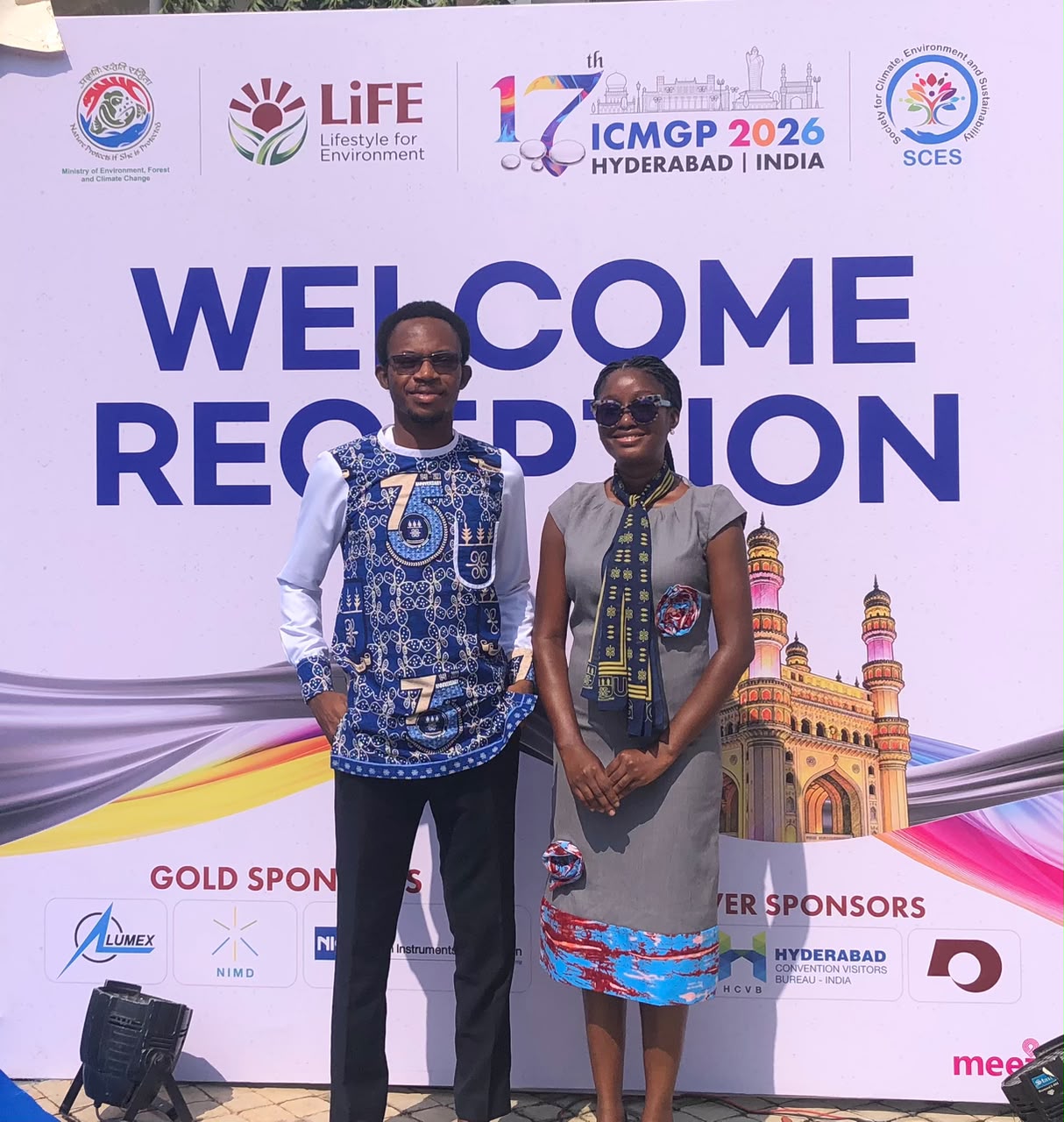
Two early-career researchers from the Institute for Environment and Sanitation Studies (IESS) won Best Poster Presentation awards at the 17th International Conference on Mercury as a Global Pollutant (ICMGP), held in Hyderabad, India, from 4–9 October 2026.
Sampson Dordaa, a first-year PhD student, presented a poster titled “Methylmercury in Ankobra River: Health and Socioeconomic Implications on Sanwoma, Western Region,” while Winnifred Aku Adotey, a Research Assistant, presented “Spatial and Seasonal Dynamics of Heavy Metals in the Pra River, Shama District, Ghana.” Their awards recognise the quality of their research and mark a notable achievement for the Institute.
Sampson’s study assessed the human and ecological risks of methylmercury in the Ankobra River. Although these risks are currently low, about one-third of residents around the estuary eat fish from the river every day. He therefore recommends continuous monitoring to guard against potential health impacts.
Winnifred’s study found that water quality in the Pra River was only marginal in both the wet and dry seasons, and poorest in the wet season. River sediments showed substantial pollution by several metals, particularly copper, cadmium and mercury. She recommends integrated river management, stronger pollution monitoring and mercury-free interventions to reduce contamination.
About the conference
They presented their work alongside many of the leading names in mercury research. The ICMGP is a biennial conference that provides a global platform for discussing mercury pollution and its environmental and health impacts. The 2026 edition brought together experts, researchers, policymakers, and other stakeholders from around the world to share knowledge, foster collaborations, and chart a course towards sustainable solutions for managing mercury pollution. The theme was “Reaching Ten Years of Enforcement of the Minamata Convention: Achievements, Challenges and Road Map for the Future.”
The conference featured a series of insightful sessions, including “Professional Skills for Early-Career Researchers in Mercury Science: Proposal Writing, Peer Review, and Science Diplomacy.” These sessions were relevant not only to mercury researchers but also to policymakers and others involved in environmental governance. They highlighted the importance of strengthening research capacity, promoting evidence-based policymaking, and fostering collaboration among scientists, policymakers, and other key stakeholders to address the global challenge of mercury pollution effectively.
Oral presentations by mercury experts and early-career researchers covered a wide range of topics, including mercury monitoring and transformation and mobilisation; mercury in oil and gas; mercury in air, freshwater and oceans; mercury in geological processes; and mercury pollution associated with artisanal and small-scale gold mining (ASGM). View the full conference programme (link).
A survivor’s story
One of the most moving moments of the conference was the account of Minamata disease survivor Masami Ogata, who described how methylmercury exposure affected his family, from his grandfather to himself and his siblings.
Why it matters for Ghana
As discussions continue globally on how to curb mercury pollution, and as countries work to ensure that the tragedy of Minamata disease is not repeated elsewhere, important questions arise for Ghana: What measures is Ghana putting in place to address mercury pollution? Do we have sufficient data on mercury contamination, especially methylmercury in our fish? Are we adequately monitoring mercury and other pollutants in our ecosystems? And do we have sufficient funding to support these initiatives? The award-winning work of Sampson and Winnifred on the Ankobra and Pra rivers, both affected by ASGM, is part of the effort to answer these questions.
Acknowledgement
The researchers wish to express their sincere gratitude to the “Building Capacity to Crosslink Coastal Pollution with Climate Change – BC5” project under the NORHED II programme, funded by Norad under “Climate Change and Natural Resources” (Grant Number: 71762), for sponsoring their participation in the conference.