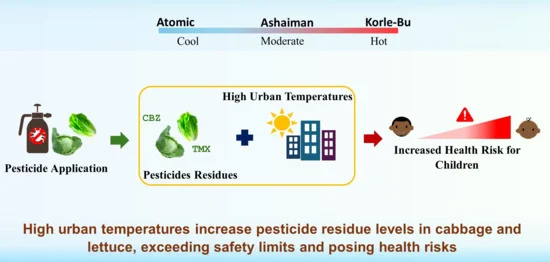
This study investigates the effect of high urban land temperatures on pesticide residue (PR) accumulation in cabbage and lettuce and on public health in the Greater Accra Metropolitan Area (GAMA) in Ghana. A comparative toxicological analysis regarding the food system was conducted with 66 farmers across three land surface temperatures: low (Atomic, n = 22), moderate (Ashaiman, n = 22), and high (Korle-Bu, n = 22). Pesticide residue concentrations were assessed using an ANOVA to examine spatial variations across sites. The results indicate a strong correlation between high land surface temperatures and pesticide residue accumulation, with lettuce recording significantly (p < 0.05) higher PR levels than cabbage. Several pesticides, including carbendazim (CBZ), Imidacloprid (IMI), Thiamethoxam (TMX), and Chlorpyrifos (CHL), exceeded the maximum residue limits (MRLs) set by the World Health Organization (WHO) and the European Union (EU) at moderate and high-temperature sites.