Building the next generation of African climate scientists takes more than technical skill. It takes the ability to translate climate science into evidence that decision-makers can act on, and that strengthens resilience where people live and work.
That conviction is at the heart of CASCADE (Cascading Climate and Health Risks in African Cities), which works with city partners to understand how climate and health risks interlink and compound. It is also why the project sponsored the two of us, Francis Adarkwah (postdoctoral researcher) and Gloria Agyei (intern), to attend the Short Course on Navigating Climate Risk.
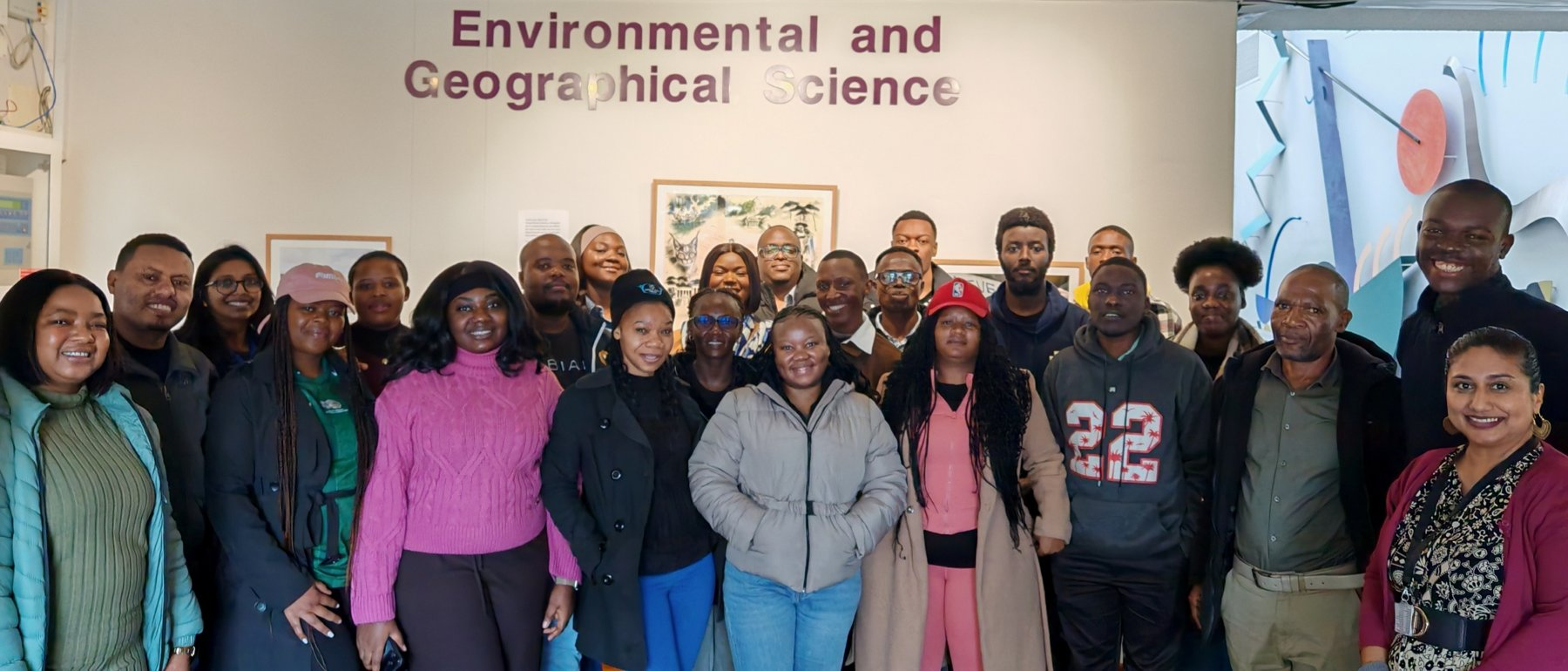
The course is run each year by the Climate System Analysis Group (CSAG) as a University of Cape Town accredited short course. The 2026 edition was hosted in the Department of Environmental and Geographical Science and brought together researchers and practitioners from across Africa, from many disciplines and sectors.
Its premise is simple and demanding: climate risk is a physical problem and a social one, and it has to be navigated as both.
Four stages, one journey
The course moved in four stages, from understanding the climate system to acting on what we know about it.
Foundations. We began with climate change and the physical climate system, alongside sessions on transdisciplinarity, co-production, ethics in climate decision-making and climate justice.
Sources and quality of climate information. We examined where climate information comes from and how far it can be trusted, including a substantial module on impact models.
Interrogating climate data. We worked through how extreme events are attributed and understood in a changing climate, and how to deal with uncertainty in climate projections and communicate it honestly.
From information to action. We closed with climate risk and vulnerability assessment frameworks, climate-resilient development pathways, and a climate justice session that placed all the technical material within questions of equity and differentiated vulnerability.
The week ended with a “Grill the Scientist” session and group presentations, in which each group applied the week’s lessons to a case study. We were in group three, and our case study was the climate, heat and health nexus, a theme that sits very close to CASCADE’s own work in African cities.
Three ideas we brought home
1. Transdisciplinarity is more than mixing disciplines
Transdisciplinarity, as the course framed it, starts from the problem and not from the discipline. It is collaborative and participatory, and it brings people outside academia into the actual production of knowledge instead of treating them as its recipients.
It also demands constant reflexivity: an ongoing check on our own assumptions about what counts as knowledge in the first place.
Participants gather around cards on the floor during one of the course’s interactive exercises.
2. Every climate decision carries values
Values are what matter to a person. Morals are what a person believes is right or wrong. Ethics is the reasoning we use when the two clash, and any decision that follows is likely to create winners and losers.
The session treated this as a practical problem, not a philosophical one. Climate risk management comes down to a series of choices, and those choices depend on values shaped by upbringing, culture, experience and worldview. Two ideas stood out for us:
Two ways of reasoning through a hard decision. A cost-benefit approach forces the question of who decides the cost and who ends up carrying it. A rights-based approach raises the harder question of whose rights come first when they conflict.
The “value web”. Climate information moves from producer to analyst to communicator to user to society. That path is not a straight line. It is a web of trust relationships that can distort information as easily as it carries it.
3. Honesty about uncertainty builds trust
Decision-makers usually want a clear answer, not a probability distribution. The course gave us practical ways to communicate how confident we are in climate projections without overstating what the science can say, and without hiding behind caveats.
What this means for CASCADE’s work in Ghana
The course reinforced CASCADE’s commitment to translating climate science into usable, locally grounded guidance. Three lessons will change how we work at the University of Ghana CASCADE office.
Using climate data with care. We are better equipped to interpret climate datasets and projections, and to account for uncertainty when we do. This will improve how CASCADE communicates confidence levels in the climate information it shares with local government partners.
Assessing risk as hazard, exposure and vulnerability. We can now apply internationally recognized frameworks for climate risk and vulnerability assessment, which feeds directly into CASCADE’s ongoing climate risk assessments.
Co-producing from the start. Engagement with policymakers, practitioners and communities belongs throughout the research process, not only at the dissemination stage.
The ethics session left a further reminder. The choices embedded in any study are value judgments, and being transparent about them is our responsibility.
We expect these lessons to show in our outputs too. Climate services, attribution of extreme events, ethical decision-making and climate-resilient development pathways give us sharper analytical lenses for publications, policy briefs, stakeholder reports and future funding proposals, so that our research is scientifically rigorous and relevant to adaptation decisions in Ghana and West Africa.
Growing as early career researchers
Climate researchers are increasingly expected to do more than generate evidence. We are asked to communicate uncertainty, facilitate engagement and co-produce knowledge that informs adaptation planning. This course strengthened our capacity to do all three.
It also widened our methodological horizon. Bridging climate science with social science, governance, ethics and community knowledge systems is how research stays responsive to real needs and keeps vulnerable communities at the centre of adaptation planning.
Just as valuable were the people. Working alongside leading climate scientists and fellow early career researchers from across Africa opened doors to interdisciplinary publications, joint proposals and continued engagement with CSAG and other institutions working on climate risk across the continent.
We return to Accra more confident and more competent as emerging climate researchers, and ready to put what we learned to work for CASCADE.
Acknowledgements
We sincerely thank CASCADE for fully sponsoring our participation in the 2026 Short Course on Navigating Climate Risk, including flights, accommodation, local transport and meals. We also thank the CSAG team and facilitators for a generous and challenging week.
About the authors
Francis Adarkwah is a postdoctoral researcher and Gloria Agyei is an intern with the CASCADE project at the University of Ghana.