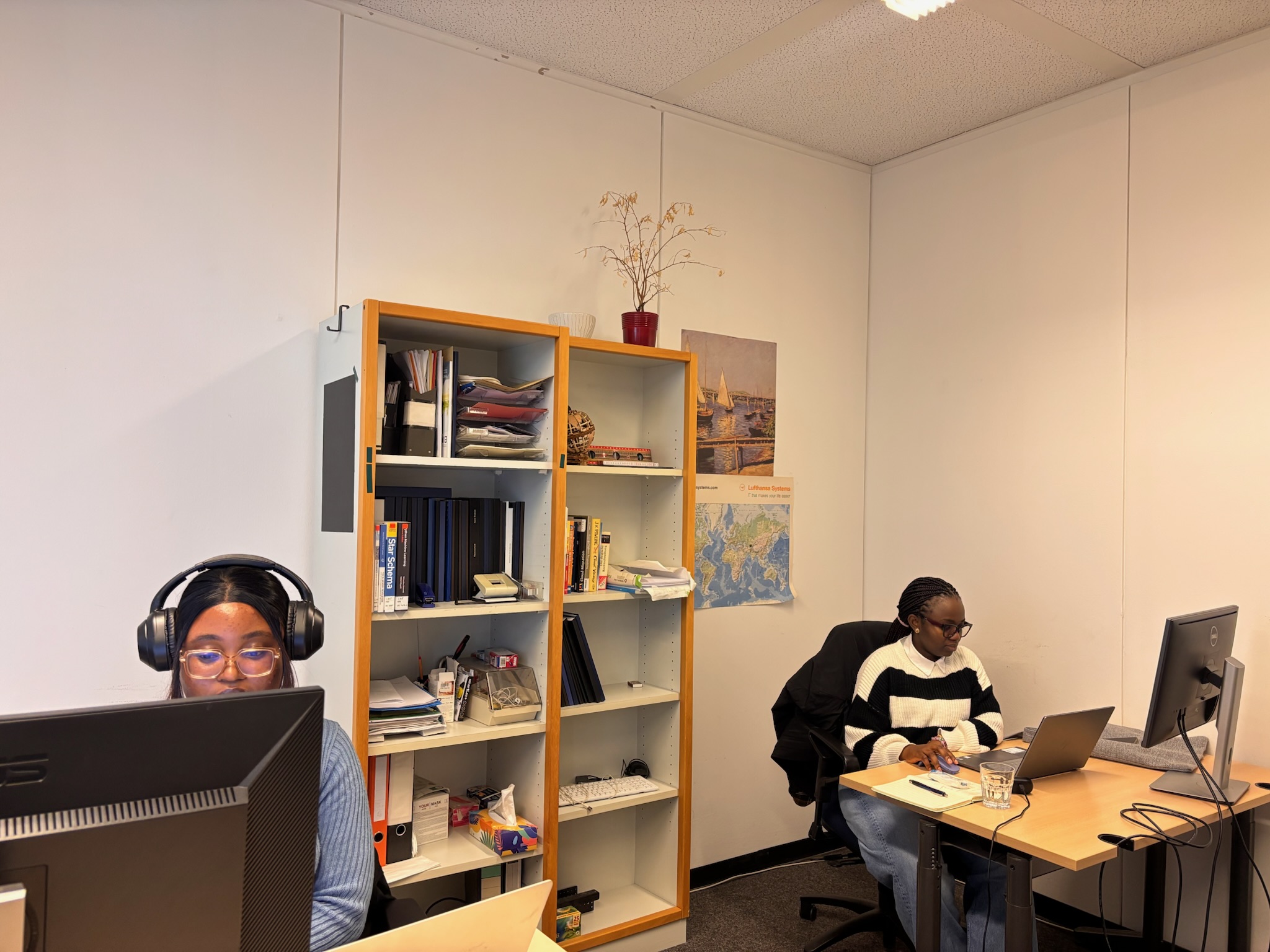
Ms. Lois Adom, a PhD candidate, and Ms. Suzzane Osei, an MPhil student at the Institute for Environment and Sanitation Studies (IESS), University of Ghana, participated in a two-week research internship at the University of Oldenburg, Germany, from 17 to 31 October 2026.
The students were hosted by the Very Large Business Applications (VLBA) Group within the Department of Computing Science under the supervision of Professor Jorge Marx Gómez. The internship was facilitated through the Network for Labour-Market Oriented Education in Waste and Water Management for the Sub-Saharan Region (NEWW), a project funded by the German Academic Exchange Service (DAAD). The NEWW partnership connects the University of Ghana, the University of Oldenburg, and the University of Arts and Technology Byumba in Rwanda, creating opportunities for students to undertake part of their research training at partner institutions.
During their stay, Lois and Suzzane engaged closely with members of the VLBA Group, gaining insights into ongoing research projects, methodologies, and software applications used in environmental and sustainability research. Both students also presented their proposed research topics and received constructive feedback from faculty and researchers, which will help refine their study designs and research proposals.
As part of the learning programme, the students visited the waste management facilities of the City of Oldenburg (AWB), where they were introduced to various components of the city's integrated waste management system. The visit included tours of the mechanical treatment plant and tunnel composting facility, as well as discussions on waste collection, separation, treatment, and disposal practices.
The internship coincided with the closing conference of the NEWW project, which was attended by a delegation from the University of Ghana. This provided an additional platform for networking, knowledge exchange, and engagement with project partners from across the region.
IESS welcomes and values such opportunities, which expose students to international research environments, advanced technologies, and practical approaches that may not be readily accessible locally. These exchanges also contribute to strengthening the Institute's research collaborations and international partnerships, particularly through strategic initiatives such as the NEWW project.