Benjamin Dankyira Ofori (PhD)
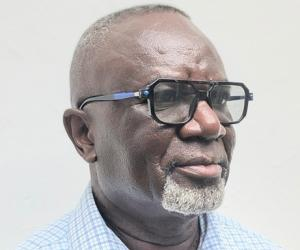
Senior Research Fellow
Benjamin D. Ofori (PhD) is a Human Geographer with special interest in Settlement Dynamics and Environmental Change, Local Markets and Service Centres, City-region Food Systems and Rural-urban Linkages, Rural Resources and Community Livelihoods, Waste Management, Resource use efficiency and Circular Economy.
He has been involved in several action-oriented research activities in the Lower Volta Basin and other extension projects aimed at addressing the challenges of rural communities and improving their livelihoods. He has experience in rural research methodologies and advocacy. He is a team player and has been collaborating with other researchers and officers in government and non-governmental institutions on many programmes. He has co-initiated several rural livelihood support programmes for several entities including Heifer Project International and provided consultancy services for the International Water Management Institute (IWMI) on community participation in dam development, the Ghana National Plastic Action Partnership (World Bank Group) among others. He has visited several countries around the world and travelled extensively in Ghana which has given him good knowledge of the country especially the Volta Basin.
Dr. Ofori has been teaching courses and supervising graduate thesis in the Institute for Environment and Sanitation Studies, University of Ghana. He has many technical reports, peer-reviewed articles in journals, and papers as book chapters and reviewed articles in conference proceedings.
Research Areas
- Local markets and domestic trade: including city-region food system, rural-urban linkages
- Climate change, vulnerability, and adaptation: with focus Community Livelihoods, especially in Dam-affected Areas
- Settlement dynamics and environmental Change: including urban growth
- Waste management, Circular Economy & Resource use Efficiency
Recent Publications
- Puplampu, K.P., Patrick, H.O., Ofori, B. D. (2023). Natural Resources Management, Sovereign Wealth Fund, and the Green Economy: Digitalization, Policies, and Institutions for Sustainable Development in Africa. In: Puplampu, K.P., Hanson, K.T., Arthur, P. (eds) Sustainable Development, Digitalization, and the Green Economy in Africa Post-COVID-19. International Political Economy Series. Palgrave Macmillan, Cham. https://doi.org/10.1007/978-3-031-32164-1_6
- Awuni S., Adarkwah, F., Ofori, B. D., Purwestri, R. C., Bernal, D. C. H. and Hajek, M. (2023). Managing the challenges of climate change mitigation and adaptation strategies in Ghana. Heliyon. Volume 9, Issue 5, May 2023, e15491
- Adjibolosoo, S. V. K., Adongo, P. B., Tawiah-Yirenya, D., Ofori, B. D., Afranie, S. (2022). Knowledge and Perception of Pupils on Health and Environmental Risk of Open Defaecation: A case Study in the First Cycle Schools in Eastern and Volta Regions of Ghana. Journal of Environment and Earth Science www.iiste.org ISSN 2224-3216 (Paper) ISSN 2225-0948 (Online) Vol.8, No.11, 2018 129.
- Ofori, B. D., Pabi, O., Nukpezah, D., Annan, J. and Wang H.C. (2021). Food System Flows and Distribution for the Accra Metropolis: Unfolding the Policy Dimensions. Legon Journal of the Humanities, Volume 32, Issue 2. 145 -169.
- Yirenya-Tawiah D, Annang, T., Ofori, B. D., Fosu-Mensah, B.Y, Lawson, E.T., Yeboah, R., Owusu-Afriyie, K., Abudey, B.,Annan, T, Datsa, C. and Gordon, C. (2020). Urban Waste as a Resource for Development: Utilization of Organic Waste to Improve Agriculture Productivity in Accra, Ghana. In Hiroshan et al (Ed), Organic Waste Composting through Nexus Thinking: Practices, Policies, and Trends. Springer, ISBN 978-3-030-36283-6, DOI 10.1007/978-3-030-36283-6, 123-145.
- Segnon A. C., Totin, E., Zougmoré, R. B., Lokossou, J. C., Thompson-Hall, M., Ofori, B. D., Achigan-Dako, E.G., and Gordon, C. (2021). Differential household vulnerability to climatic and non-climatic stressors in semi-arid areas of Mali, West Africa. Climate and Development 13(8):697-712.
- Baa-Poku, F., Ayivor, S. S., & Ofori, B. D. (2020). Changing Agricultural Practices and Indigenenous Food Crops in the Upper Afram Basin of Ghana. Ghana journal of Agricultural Science, 55(1), 65-74.
- O. Pabi, A. Adu-Asare, B. D. Ofori (2020). Linking Optical SPOT and Unmanned Aerial Vehicle data for a rapid biomass estimation in a Forest-savanna Transitional Zone of Ghana. West African Journal of Applied Ecology. Vol. 28, Issue 1. Pp 1-12
- Adjibolosoo SV, Ofori BD, Adongo PB, Afranie S, Yirenya-Tawiah DR (2020) The influence of culture on open defaecation in some basic schools in selected districts in Ghana: A preliminary study. PLoS ONE 15(10): e0239491. https://doi.org/10.1371/journal.pone.0239491
- Nukpezah, D., Ofori, B. D. and Adu-Manu, K.S (2019). Application of Industrial Ecology Principles to the Management of Industrial By-products in Ghana: A conceptual framing, In J. Marx Gomez et al. (Hrsg.), Smart Cities/Smart Regions-Technische, wirtschaftliche und gesellschaftliche Innovationen, Springer Fachmedien Wiesbaden GmbH, ein Teil von Springer Nature. Pp. 563-572.
- Pabi, O., Ayivor, J. S. & Ofori, B. D. (2019). Climate change-induced adaptive strategies of the small-scale farming system in the Forest-Savanna Transitional Zone of Ghana. West African Journal of Applied Ecology 27(2):88-105
- S. Adjibolosoo, S., Adongo, P. B. Yirenya-Tawiah, D., Ofori, B. D. and Afranie, S. (2018). Behavioural Factors That Influence Open Defaecation among Pre-secondary School Pupils in the Eastern and Volta Regions of Ghana. West African Journal of Applied Ecology (WAJAE)- Vol 26 (SI), 2018: 203 – 227.
- Environmental Protection Agency (2017). Ghana State of the Environment Report. Environmental Protection Agency, Ministry of Environment, Science, Technology and Innovation, Accra. Member of Lead Authorship (authored the Population and Transport components)
- Ofori, B. D. and Ayivor, J. S. (2017). Institutional Capacity and Management of The Volta Lake Shores and The Lower Volta River Channel. In Ntiamoah-Baidu, Y., Ampomah, B. Y., and Ofosu, E. A. (Eds). Dams, Development & Downstream Communities: Implications for Re-Optimising the Operations of The Akosombo and Kpong Dams in Ghana. pp. 321-337.
- Ofori, B. D. and Ayivor, J. S. (2017). Institutional Capacity and Management of The Volta Lake Shores and The Lower Volta River Channel. In Ntiamoah-Baidu, Y., Ampomah, B. Y., and Ofosu, E. A. (Eds). Dams, Development & Downstream Communities: Implications for Re-Optimising the Operations of The Akosombo and Kpong Dams in Ghana. pp. 321-337.
Recent Research Projects
- Coastal Community Resilience to Climate Change and Diarrhoea [C2r-Cd] Project, Lead for Work Package 5, Community Involvement, Mobilization and Education for Impact.
- Building Capacity to Crosslink Coastal Pollution with Climate ChangeBC5 - a strategic north-south collaboration between the Norwegian University of Science and Technology (NTNU), the University of Ghana (UG) & affiliated collaboration by University of Dar Es Salaam, Tanzania. BC5 addresses the thematic area «Climate Change and Natural Resources» under NORHED II. BC5 aims at building knowledge on sustainable management of marine coastal ecosystems and resources, strengthening & improving existing regional coastal research.